


How IATSE Local 891 gave its members an accessible introduction to AI
Güneş Özgün, Product Engineer
IATSE Local 891 is the largest IATSE local in North America: over 9,000 professional artists and technicians in the film and television crafts across British Columbia and the Yukon. Chartered in 1962, its mission is to represent and support the people who make productions happen behind the scenes. As AI began reshaping that industry, the union partnered with Scholé to give its members an accessible, low-pressure way into the technology, and the pilot gave a wary workforce a genuine first step into AI.
- 8+ out of 10
- rated by a third of a workforce that arrived cautious about AI
- 1,200+ activities
- completed across 40+ AI lessons
- ~4 hrs/week
- of learning, in focused 37-minute sessions
The challenge
IATSE Local 891 is not one trade but dozens. Its more than 9,000 members work across 19 departments, each craft with its own language, tools and workflow. What they share is that their work is hands-on and creative, built on human skill rather than software.
AI raises real questions for work like this. It is abstract, it moves fast, and it bears directly on the future of the crafts, so members’ caution was well-founded rather than a misunderstanding to correct. When the pilot began, members rated their comfort with AI tools at 3.5 out of 10 on average, and the feeling most of them described was more concern than excitement, a position many British Columbians share. Local 891 chose to face that head on.
The union wanted to give its members a way in, but the usual options didn’t fit. A single generic course couldn’t speak to a props buyer, a sound assistant and a picture editor at once, and a stack of videos would leave the hardest part, knowing where to start and why, entirely on the learner. Local 891 needed something that could meet a large, varied and understandably wary membership as individuals.
Why Scholé
Local 891 chose Scholé because it doesn’t teach everyone the same lesson the same way. Scholé is a multi-tutor learning tool that meets learners where they are, adapting to each person’s level and building a path around their role and goals.
For a membership this varied, that adaptivity was the point. Someone who had never opened an AI tool and someone who used them daily could start in the same program and still get something pitched to them, rather than a one-size-fits-all curriculum that would lose one and bore the other. Just as important for a wary audience, Scholé removed the intimidating blank-page problem: instead of asking people to work out what to learn about AI, it proposed a place to begin and a reason for each step, so getting started took very little expertise.
That combination, personalized to the individual but guided rather than open-ended, was what the union had been unable to find anywhere else.
What they used
- Guided onboarding
- Olé tutor
- Tailored learning paths
- Interactive lessons
- Explainer videos
Every member started with a short onboarding that asked about their department, classification, the tools they already use and what they hoped to get out of the pilot. From that profile, Scholé’s recommendation system built each learner their own path, so the first lesson felt relevant rather than generic.
From there, members learned alongside Olé, Scholé’s guiding tutor, who introduces ideas, asks questions and adjusts as it goes. Lessons mixed short explanations with interactive activities, quizzes, fill-in-the-blank, matching and sequencing, so members were doing something rather than only reading, plus explainer videos with audio narration for those who preferred to watch or listen.
What worked for this very specific learner population? The AI literacy foundations resonated most. Lessons on what AI actually is, how agentic and generative AI differ from the software members already knew, gave people who had felt shut out of the topic a solid, unintimidating footing. And because the path was a suggestion rather than a rulebook, members could follow their curiosity, revisit anything, or steer Olé toward the areas that mattered to their own work.
Where members were clearest was about how they learn best: by doing. Across surveys and debriefs, the thing they asked for most was the chance to try a tool themselves rather than read about it. As one member put it, “a module example shown, and then you can try your own version.” That’s the strongest steer the pilot gave us, and it’s what we’re building next: a browser extension that lets learners practice in real tools, with Olé guiding them and giving feedback in the moment. More on that soon.
The results
The clearest signal was how the members themselves responded. This is a group that arrived rating their own expertise with AI at 3.5 out of 10. Thirty days later, the exit survey put that at 5.6 for assistive tools and 5.4 for generative ones, a real step up for a workforce that had described itself as cautious rather than curious. A third of members, 26 of the 79 who rated the pilot, scored the experience 8 or higher out of 10.
How members rated their own AI expertise, before and after the pilot
Each member scored themselves from 0, meaning no expertise at all, to 10, meaning highly experienced. The figures below are the averages across everyone who answered both surveys.
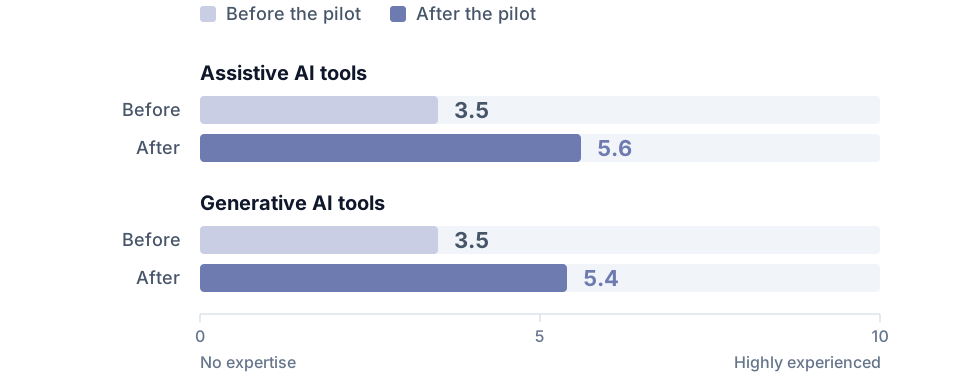
Self-reported by members in the pre- and post-pilot surveys. Self-ratings measure confidence, not tested skill.
The pilot also reached clear across the membership. Participants came from 19 different crafts and classifications, and they treated it as real learning rather than a box to tick. Competing with demanding production schedules, members came back week after week in short, focused sessions, watching more than 120 explainer videos through to the end and working through close to 300 individual lesson sections between them.
Many made the path their own, adjusting their recommended journey or creating new lessons on topics closer to their craft, exactly the kind of self-directed learning the pilot was meant to encourage.
The members the program served best were the ones it was designed for: people who came in knowing little about AI and left with the confidence to keep going.
“Our members’ caution about AI is well-founded, and their desire for learning equally so, and we chose to face it head on. Scholé was remarkably responsive and open to our members’ feedback as direction and kept improving the tool alongside us. Our members left with a tangible foothold in new territory, and we look forward to partnering again.”